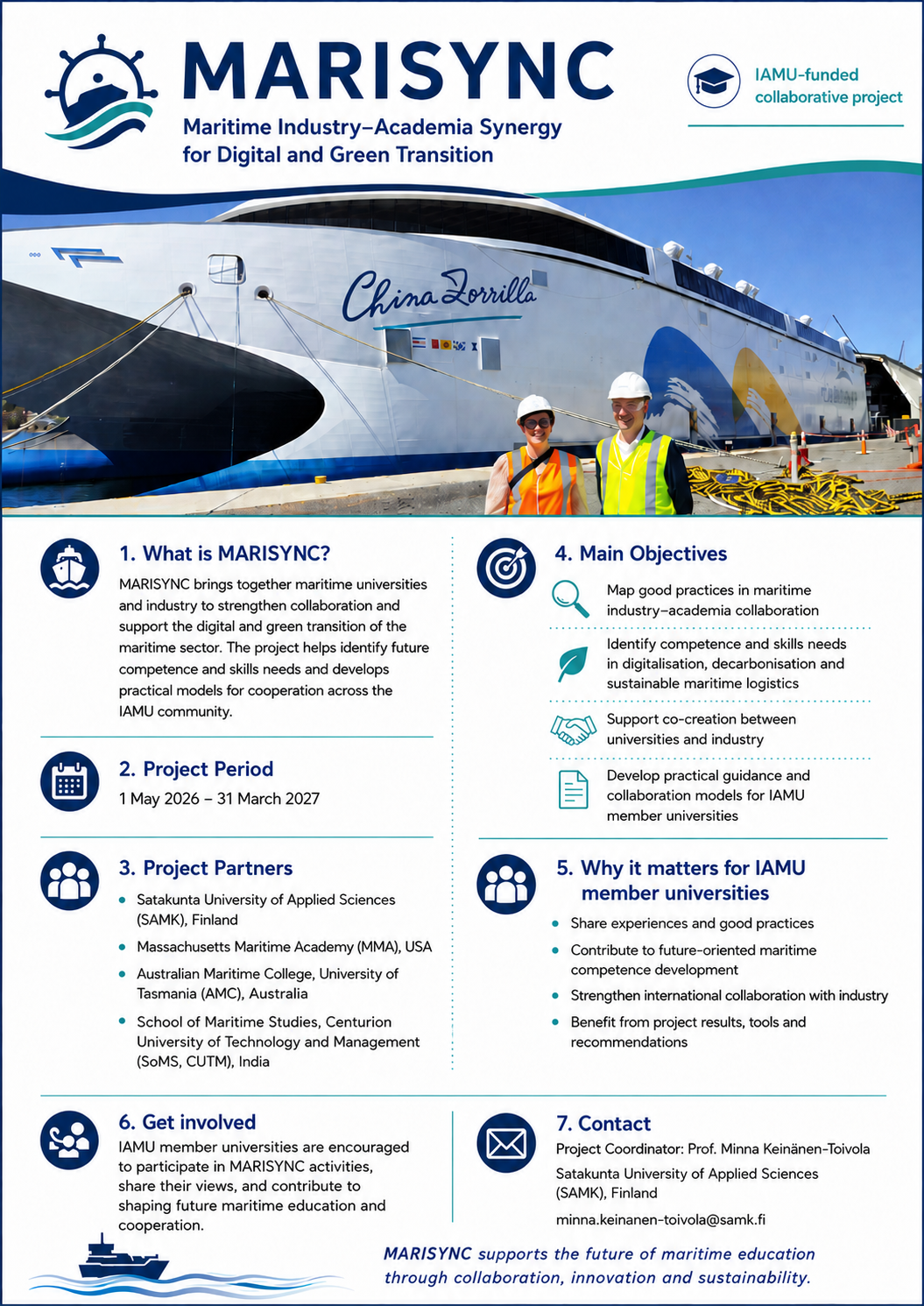
MARISYNC is an international development project coordinated by Satakunta University of Applied Sciences (SAMK) in cooperation with Massachusetts Maritime Academy (USA), Australian Maritime College (Australia), and the School of Maritime Studies, Centurion University of Technology and Management (India). The project develops new operational models that strengthen long-term cooperation between higher education institutions and the maritime industry.
The key themes of the project are digitalization, decarbonization, and sustainable maritime logistics solutions. MARISYNC supports the strategic objectives of the IAMU network by producing concrete collaboration models, competence mapping tools, and impact data for the needs of maritime education and industry.
In addition, the project develops a prototype digital collaboration platform to strengthen knowledge exchange, co-creation of expertise, and international cooperation between IAMU member universities and maritime industry stakeholders.
Contact:
Minna Keinänen-Toivola
Chief Researcher, Adjunct Professor, Ph.D., MSc., MBA
Satakunta University of Applied Sciences (SAMK)
Maritime Logistics Research Center
minna.keinanen-toivola@samk.fi
Project objectives
- Develop a shared university–industry collaboration model for the IAMU network
- Identify competence and skills needs related to digitalization, decarbonization, and sustainable maritime logistics
- Produce statistical data illustrating IAMU’s impact on the maritime industry
- Develop a prototype digital collaboration platform for the IAMU network
- Strengthen international cooperation between maritime education institutions and industry stakeholders
Projects steps
- Benchmark international university–industry collaboration models
- Organize co-creation workshops with maritime industry stakeholders
- Conduct competence and needs mapping activities in different regions
- Develop statistical impact data related to the IAMU network
- Build a prototype digital collaboration platform
- Evaluate the functionality and scalability of the developed models through piloting and stakeholder feedback
- Disseminate project results through the IAMU network and international cooperation channels